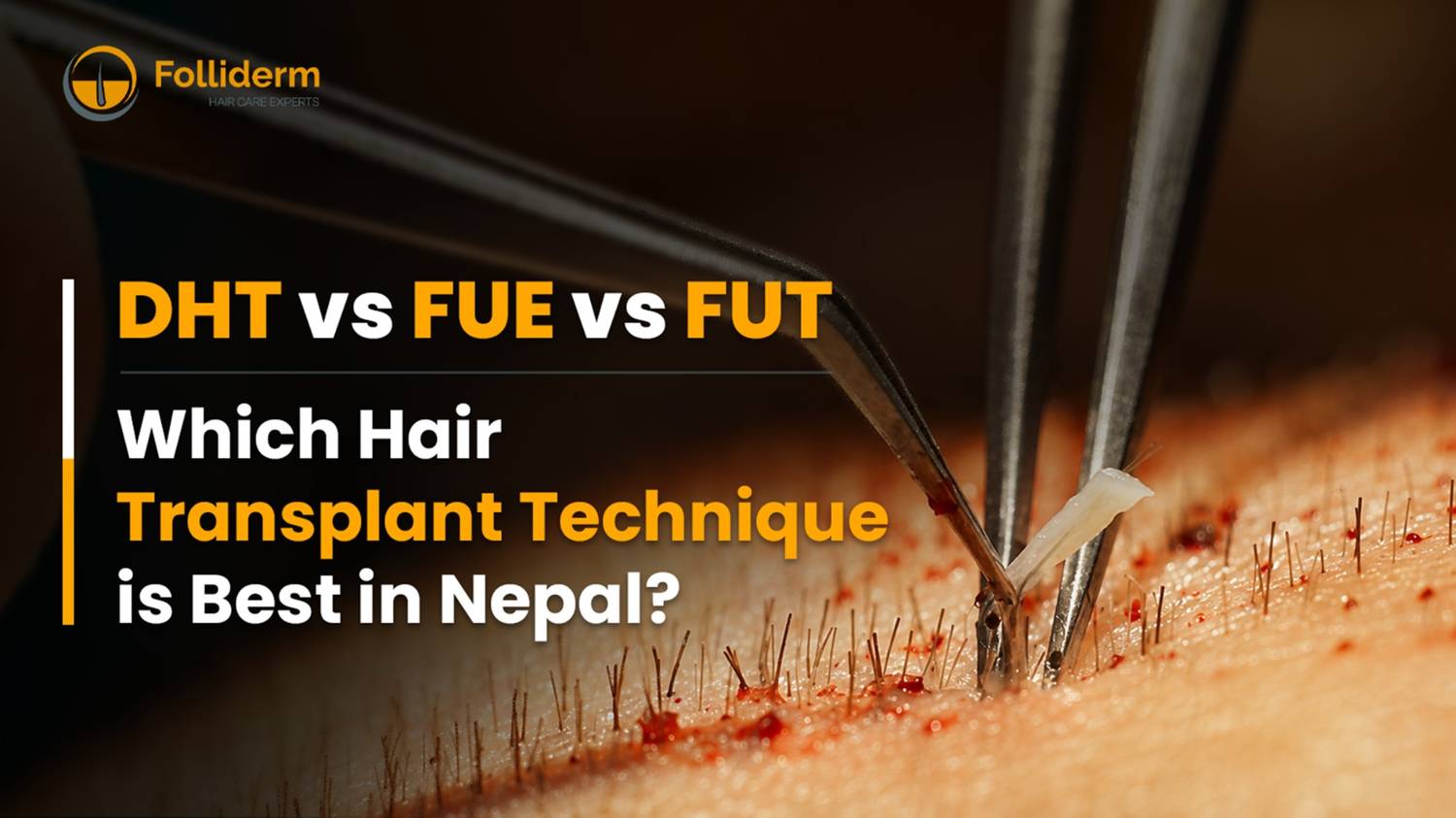
You have finally decided to do something about your hair loss. You have researched clinics in Kathmandu, read a few websites, and watched a couple of videos. And then you hit a wall.
Every clinic uses a different name. One says FUE. Another says DHT. A third mentions FUT. Some clinics list all three on the same page, as if they are just flavors on a menu.
You are left wondering: are these actually different? Does it matter which one I choose? And is the more expensive option actually better, or is it just marketing?
These are the right questions to ask. The technique genuinely matters not just for the cost, but for how your hair grows, how natural it looks, whether you will need a second procedure, and how your scalp recovers.
This guide breaks down exactly what FUT, FUE, and DHT are in plain language, without clinic bias, so you can walk into any consultation in Nepal knowing what to ask and what to expect.
QUICK ANSWER
DHT (Direct Hair Transplant) achieves nearly 100% graft survival by implanting each follicle within 2-20 minutes of extraction. Standard FUE stores grafts outside the body for 1-2 hours or longer, which can reduce survival due to graft handling or mechanical injury. FUT requires a strip of scalp to be surgically removed, leaving a permanent linear scar. For patients seeking maximum density and natural-looking results with no scarring, DHT is the most advanced technique available in Nepal today.
What is FUT (Follicular Unit Transplantation)?
FUT is the oldest of the three techniques and the one you are least likely to see recommended at modern clinics in Nepal today. But it is worth understanding because it is the foundation on which everything else is built.
In a FUT procedure, the surgeon removes a thin horizontal strip of scalp skin from the back of your head, usually between 15 and 25 centimeters long. That strip is taken to a separate table, where a team of technicians dissects it under a microscope, separating it into individual hair-follicle units. Those follicles are then implanted into the recipient area where you are experiencing hair loss.
The wound from the strip removal is closed with stitches or staples. This leaves a permanent linear scar across the back of your head.
Who is FUT suited for?
FUT can still make clinical sense in specific situations, particularly when a patient has very advanced baldness (Norwood Grade 6 or 7) and needs the highest possible number of grafts in a single session. A skilled surgeon can harvest 3,000 to 5,000+ grafts from one strip, which is difficult to match with FUE in a single sitting.
The real trade-offs of FUT
- A permanent linear scar across the donor area is visible if you ever cut your hair short
- Longer recovery: 2-3 weeks before the wound fully heals
- More postoperative discomfort than FUE or DHT
- Graft survival rates of 85-90% grafts spend time in a storage solution before implantation
- Declining in use, FUE and DHT have improved, but are still available at some clinics in Nepal
Is FUT still used in Nepal in 2026?
Yes, a small number of clinics still offer FUT, primarily for patients who require very large graft counts and have limited donor hair. However, most experienced surgeons in Nepal and globally have shifted to FUE and DHT for most cases because scar-free outcomes and faster recovery are simply better for patients.
What is FUE (Follicular Unit Extraction)?
FUE is currently the most widely used hair transplant technique in Nepal and worldwide. Walk into almost any hair transplant clinic in Kathmandu today, and FUE is almost certainly what they offer.
Instead of removing a strip of scalp, FUE extracts hair follicles one by one from the donor area using a tiny circular punch instrument, usually less than 1mm in diameter. Each follicle is extracted and collected individually. Once enough follicles have been harvested, the surgeon creates small incisions in the recipient area and implants the follicles.
Because there is no strip removal, there is no linear scar. The extraction sites heal as tiny dot-shaped marks, barely visible even with short hair. Recovery is faster than FUT; most patients return to a desk job within 7-10 days.
Why FUE became the standard, and it’s one major limitation
FUE was a genuine improvement over FUT. Less pain, no scar, faster healing. But there is a biological issue with standard FUE that most clinics do not clearly advertise.
After a follicle is extracted, it goes into a storage solution, a saline or ATP-enriched liquid, and waits there while the rest of the extraction continues. In a typical FUE session, grafts can spend 1 to 2 hours outside the body before they are implanted.
Here is why that matters: hair follicles are living tissue. Every minute they spend outside the scalp, they are at risk of desiccation (drying out), oxygen deprivation, and mechanical trauma from handling. Research published in peer-reviewed dermatology journals shows that graft survival rates in standard FUE typically fall in the range of 60-70%, meaning that in some cases, up to 30-40% of the grafts you paid for may not produce hair.
For patients paying tens of thousands of rupees per graft, that is a significant number. It also explains why some patients who undergo FUE at cheaper clinics end up needing a second procedure.
Pros and cons of FUE
- No linear scar, tiny dot marks that heal invisibly in most patients
- Faster recovery than FUT: most patients are back to normal in 7-10 days
- Less postoperative pain and discomfort than FUT
- Widely available across Nepal and internationally
- Limitation: Graft survival rate of 60-70% in standard FUE grafts stored 1-2 hours before implantation
- Limitation: Results are highly dependent on the surgeon’s and technician’s skill during graft handling
What is DHT (Direct Hair Transplant)? The Most Advanced Technique
DHT stands for Direct Hair Transplant, and it is a modification of FUE designed to solve the one fundamental weakness of standard FUE: the time grafts spend outside the body.
In DHT, the extraction and implantation happen simultaneously. As follicles are extracted from the donor area, they are immediately implanted into the recipient area without being placed in any storage solution. The out-of-body time for each graft is reduced from 1-2 hours to just 2-20 minutes.
This is not a minor procedural tweak. It is a fundamentally different biological outcome.
Why graft survival time matters in science
Hair follicles are metabolically active tissue. When they are removed from the scalp, they immediately begin to use up their stored energy (ATP). Without oxygen or nutrients from blood flow, they begin to deteriorate. Research on follicular unit survival rates shows that:
- Grafts implanted within 30 minutes have the highest survival rates
- Grafts stored for 1-2 hours show a measurable decline in cell viability
- Grafts stored beyond 4-6 hours show significantly reduced survival
DHT eliminates the storage window almost entirely. The follicle goes from the donor scalp to the recipient scalp in under 20 minutes. This is why DHT consistently achieves graft survival rates approaching 100%, meaning virtually every graft you receive actually grows.
How implantation is performed matters just as much
Reducing out-of-body time addresses when grafts are at risk. But the implantation method itself determines how much mechanical stress the graft receives at the moment it is placed. In standard FUE, grafts are implanted with forceps, meaning the root of each follicle is touched and compressed during placement. This mechanical handling can damage the follicle at the final stage of the procedure, reducing viability even in grafts that survived storage well. In true DHT at Folliderm, implantation is performed using SAVA implanters rather than forceps. This allows a no-root-touch technique: the root of each graft is never directly handled during placement. Minimizing mechanical trauma at implantation, combined with minimizing time outside the body, is why DHT achieves the graft survival rates it does.
From Dr. Pramod Agrawal, Head Surgeon, Folliderm
“In twelve years of performing hair transplants, the difference in density outcomes between DHT and standard FUE patients is consistently visible at the 12-month mark. Graft survival is not a marketing claim it is measurable biology. When you reduce the time a follicle spends outside the body from 90 minutes to 10 minutes, you are giving that follicle a fundamentally better chance of survival. That translates directly into how dense, how natural, and how permanent the patient’s result looks.”
Dr. Pramod Agrawal, MD Dermatology (AIIMS New Delhi) | 2,500+ procedures
The advantages of DHT
- 100% graft survival, immediate implantation eliminates storage-related cell death
- No stitches, no linear scar, same dot-scar profile as standard FUE
- Fastest recovery of all three techniques, most patients return to work in 5-7 days
- Maximum natural density means more surviving grafts, which means visibly fuller results
- Precise control over the angle and direction of each implanted hair, and a superior hairline design
- Effective for hairline reconstruction, eyebrow, beard, and female hair transplants
Folliderm is the pioneer of DHT in Nepal.
Folliderm was among the first clinics in Nepal to adopt and perfect the DHT technique. All hair transplant procedures at Folliderm use DHT exclusively and are performed directly by Dr. Pramod Agrawal, an AIIMS New Delhi-trained dermatologist with over 2,500 procedures and 12+ years of experience. DHT at Folliderm is not performed by technicians. Every graft, every implantation, is supervised and executed by the doctor himself.
DHT vs FUE vs FUT Side-by-Side Comparison
Here is how the three techniques compare across every factor that matters:
| Factor | FUT (Strip) | FUE | DHT |
|---|---|---|---|
| Scarring | Linear scar (permanent) | Tiny dot scars | No scars, no stitches |
| Graft survival rate | 70-80% | 60-70% | ~100% |
| Recovery time | 2-3 weeks | 7-10 days | 5-7 days |
| Pain level | Moderate-High | Low-Moderate | Low |
| Cost per graft (Nepal) | Rs 40-55 | Rs 50-70 | Rs 65-90 |
| Natural hairline result | Good | Very good | Excellent |
| Best for | Advanced baldness | General cases | All cases |
| Available at Folliderm | No | No | Yes – exclusively |
Table based on Folliderm clinical data and published hair transplant research, 2026. Individual results may vary based on patient hair quality, surgeon experience, and post-operative care.
Which Hair Transplant Technique is Right for You?
The honest answer is: it depends on your stage of hair loss, your goals, your budget, and the surgeon you are working with. Here is a practical guide.
By Norwood Grade (baldness stage)
- Norwood Grade 1-3 (early recession, hairline): DHT is ideal. Precise graft placement and near-100 % survival yield the most natural-looking result at the hairline.
- Norwood Grade 3-5 (moderate hair loss, crown thinning): DHT produces excellent outcomes. A session of 1,500-3,000 grafts typically achieves full coverage.
- Norwood Grade 6-7 (advanced baldness): DHT can still work well, though multiple sessions may be needed. Dr. Agrawal assesses donor density at your free consultation.
- Repair of a failed previous transplant: DHT is the recommended technique; maximizing the survival of the limited remaining donor hair is critical in these cases.
The cost question is why cheaper FUE can end up costing more
This is the most misunderstood financial calculation in hair transplants. Here is how to think about it correctly.
Suppose you need 2,000 grafts. A clinic offers FUE at Rs 60 per graft, for a total Rs 1,20,000. Folliderm offers DHT at Rs 80 per graft, for a total of Rs 1,60,000. The FUE option looks Rs 40,000 cheaper.
But here is what changes when graft survival is 60-70% instead of ~100%:
- At 60-70% survival on 2,000 grafts, 600-800 grafts may not grow
- You effectively received 1,200-1,400 functioning grafts, not 2,000
- To achieve your original density goal, you now need another 600-800 grafts, another procedure
- That second procedure at Rs 60 per graft adds Rs 36,000-48,000 to your total cost
- Plus the emotional cost of waiting another 12 months to see a result that should have been there after the procedure one
When you account for the full picture, DHT’s higher per-graft cost often results in a lower total cost and a single procedure rather than two.
Frequently Asked Questions
1. Is DHT better than FUE for hair transplant?
Yes, for the majority of patients. The key advantage is graft survival. Standard FUE stores follicles outside the body for 1-2 hours before implantation, reducing survival to 60-70%. DHT implants grafts within 2-20 minutes, achieving survival rates approaching 100%. This means more of your transplanted hair actually grows, resulting in better density, more natural results, and fewer patients needing a second procedure. The technique is also gentler on the scalp and leads to faster recovery.
2. What is the graft survival rate for DHT vs FUE in Nepal?
With standard FUE at most clinics in Nepal, graft survival rates typically range from 60-70%, meaning 30-40% of transplanted follicles may not produce hair. With DHT at Folliderm, graft survival approaches 100% because follicles are implanted within minutes of extraction, eliminating storage-related cell death. This difference is the single most important factor in the density and permanence of your hair transplant result.
3. Does DHT leave a scar?
No. Like standard FUE, DHT does not require removal of a strip of scalp, so there is no linear scar. Extraction sites heal as tiny dot-shaped marks that are virtually undetectable, even with very short hair. This is one of the key reasons most patients today choose either FUE or DHT over FUT, which does leave a permanent horizontal scar across the back of the head.
4. Which technique is best for Grade 5 or Grade 6 baldness?
DHT remains a strong choice for Grade 5 and 6 baldness, though the approach depends on the quality and density of your donor hair, which Dr. Agrawal assesses at your free consultation. Patients with sufficient donor hair can typically achieve excellent coverage in one DHT session. In some advanced cases, multiple sessions may be recommended to achieve the best result without depleting the donor area.
5. Why is DHT more expensive than FUE in Nepal?
DHT requires a precisely synchronized surgical team working in two areas of the scalp simultaneously, one extracting, one immediately implanting. This demands a more skilled, larger team and more surgical time per graft. At Folliderm, all DHT procedures are performed and supervised directly by Dr. Pramod Agrawal himself, rather than delegated to technicians. When you factor in the superior graft survival rate, the total cost of achieving your hair goals is typically equal to or lower than standard FUE.
6. Is FUT still used in Nepal in 2026?
Yes, but it is increasingly rare. A small number of clinics still offer FUT for cases requiring very large graft counts in a single session, typically Grade 6 or 7 baldness with very limited donor hair. However, most qualified surgeons in Nepal now recommend FUE or DHT for most patients. If a clinic recommends FUT for a Grade 3 or 4 case, it is worth seeking a second opinion.
7. Which clinic in Nepal offers the DHT technique?
Folliderm in Kathmandu is among the pioneers of DHT in Nepal and one of the very few clinics offering it under the care of a fully qualified surgeon. DHT at Folliderm is performed directly by Dr. Pramod Agrawal, MD Dermatology, AIIMS New Delhi, with 12+ years of experience and over 2,500 procedures. A free initial consultation is available to assess your suitability and discuss an approach tailored to your specific hair loss pattern.
The One Thing Most Clinics Will Not Tell You
The technique is only part of the equation.
The most advanced technique in the world, in the wrong hands, produces poor results. And a skilled, experienced surgeon using standard FUE can sometimes produce better results than an inexperienced surgeon attempting DHT.
What actually determines the outcome of your hair transplant:
- The surgeon’s experience is how many procedures they have personally performed, not their team
- Whether the surgeon performs the procedure directly or delegates it to technicians
- The quality of graft handling, including how grafts are stored, transported, and implanted
- Hairline design, a natural-looking hairline requires artistic judgment, not just surgical skill
- Post-operative care and follow-up, and whether the clinic is reachable if something goes wrong
When you evaluate a hair transplant clinic in Nepal, ask these specific questions before making a decision:
- Will the doctor personally perform the extraction and implantation, or will technicians do it?
- What is this clinic’s graft survival rate, and how is it measured?
- Can I see before-and-after photos of patients at 12 months post-procedure, not just 6 months?
- What are the surgeon’s credentials, and how many of these procedures have they personally completed?
- What happens if my results are not satisfactory? What is the clinic’s follow-up policy?
The answers will tell you more about the clinic than any number on a price list.
Making the Right Decision for Your Hair
If you have read this far, you now understand something most people walking into a hair transplant clinic in Nepal do not know: the technique is not just a name. The difference between a graft survival rate of 65% and 98% is clear. It shows up in your mirror 12 months after the procedure.
FUT is the oldest technique still relevant for specific advanced cases, but not the choice of most modern surgeons. FUE improved on FUT by eliminating the scar, but still carries the limitation of extended graft storage time. DHT addresses that limitation directly: the same no-scar profile as FUE, with dramatically higher graft survival through immediate implantation.
The right technique for you depends on your specific hair loss pattern, donor area quality, and goals, and that is a conversation worth having with an experienced surgeon before you make any financial decision.
Not sure which technique suits your hair loss? Book a free consultation with Dr. Pramod Agrawal at Folliderm, Nepal’s only AIIMS New Delhi-trained hair transplant surgeon and pioneer of DHT in Nepal. In one appointment, you will know exactly which technique is right for your pattern, how many grafts you need, what the result will look like, and what it will cost.
Medical References
1. Limmer BL. Micrograft survival. Dermatol Clin. 1995;13:469-72. Foundational study on time-out-of-body and graft survival.
2. Dua A, Dua K. Follicular unit extraction hair transplant. Journal of Cutaneous and Aesthetic Surgery. 2010. PMC3056960.
3. International Society of Hair Restoration Surgery (ISHRS) ishrs.org global standards for hair transplant practice.
4. Direct Hair Transplantation: A Modified Follicular Unit Extraction Technique. PMC3764754. National Center for Biotechnology Information.
About the author
Dr. Pramod Agrawal is a dermatologist and hair transplant surgeon based in Kathmandu, Nepal. He completed his MD in Dermatology at AIIMS, New Delhi, and has performed over 2,500 hair transplant procedures across more than 12 years of practice. He is the founder of Folliderm and a pioneer of the DHT (Direct Hair Transplant) technique in Nepal. All clinical content on this blog is written or reviewed by Dr. Agrawal personally.
This article is intended for informational purposes. Individual hair transplant suitability varies. Please consult a qualified surgeon for a personal assessment.